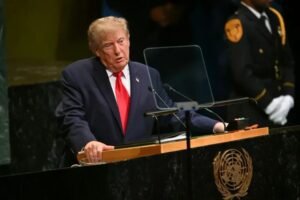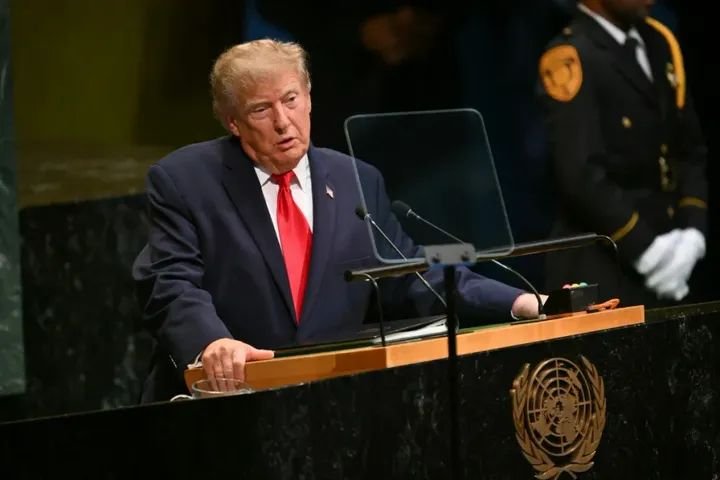
US President Donald Trump has dismissed suggestions that his leadership and policies contributed to the Republican Party’s losses in the midterm elections, instead blaming the party’s candidates for failing to inspire voters.
The election outcome, which handed Democrats control of both chambers of Congress on Tuesday, has raised fresh questions about Trump’s political influence and the direction of his administration as he enters the remainder of his term.
Despite the setback, Trump insisted that the results should not be interpreted as a rejection of his presidency, arguing that his administration had recorded significant achievements, particularly in the economy.
“But I don’t view it as a hit on me,” he told Fox News during a live phone interview.
“We’ve had the greatest two years in the history of the presidency in terms of the economy, in terms of all the things that we’ve done,” he added.
Rather than accept responsibility for the party’s poor performance, Trump argued that individual Republican candidates failed to generate enough enthusiasm among voters. He also criticised what he described as favourable media coverage of Democratic candidates, singling out Fox News.
“I thought they’d do better,” he said, admitting that the results came as a “little surprise”.
The President had played an active role in the campaigns, travelling to Republican-leaning states to rally support for candidates and urging voters to “pretend I’m on the ballot”.
However, the strategy failed to deliver the expected outcome, with Democrats making significant gains despite his efforts to mobilise Republican supporters.
“They just didn’t inspire the people to get out and vote,” Trump said.
“And I wasn’t on the ballot. If I was on the ballot, they would have got out.”
Several Republican candidates who lost their races, including Darline Graham in South Carolina, Ken Paxton in Texas, Michael Whatley in North Carolina and Mike Collins in Georgia, had received Trump’s endorsement.
Some of his endorsements had reportedly gone against the preferences of other Republican leaders, raising questions about his influence over the party’s candidate-selection process.
Trump, however, defended his decision to support Paxton over incumbent Senator John Cornyn in Texas, saying he had little choice but to back his preferred candidate.
“I had no choice,” he said, adding that Paxton had remained loyal to him when doing so was unpopular.
In a post on his Truth Social platform shortly before midnight, Trump indicated that he would examine the reasons behind the defeats and publicly assess the candidates’ performances.
“I’m going to become a Political Pundit, both good and bad, on the reasons these Candidates won and lost!” he wrote.
He also turned his criticism towards Texas Governor Greg Abbott, describing him as a “Republican in name only” and accusing him of returning to a political strategy that had previously failed.
Despite his criticism of individual candidates, Trump adopted a different tone in an interview with Politico, saying he was not interested in assigning blame for the election outcome.
“I don’t want to blame anybody,” he said, describing the election period as an opportunity to observe and learn from the results.
With Democrats now holding greater influence in Congress, Trump also expressed willingness to work with members of the opposition party, saying he had already spoken with some Democratic politicians without identifying them.
“You know, I have a lot of friends that are Democrats. Believe it or not, I’ve already spoken to some of them,” he said.
The prospect of bipartisan cooperation will be closely watched, particularly as Democrats prepare to exercise greater influence over legislative decisions in Washington. Trump had made similar calls for cooperation after Republican losses in the 2018 midterm elections, although those efforts produced limited results.
Meanwhile, the President dismissed suggestions that he regretted launching the war in Iran, an issue some Republicans have identified as a possible factor in the party’s poor electoral performance.
Asked by The Wall Street Journal whether he regretted the military action, Trump maintained that he had made the right decision.
“I don’t think about it. I did the right thing,” he said.
“I would have done it again.”